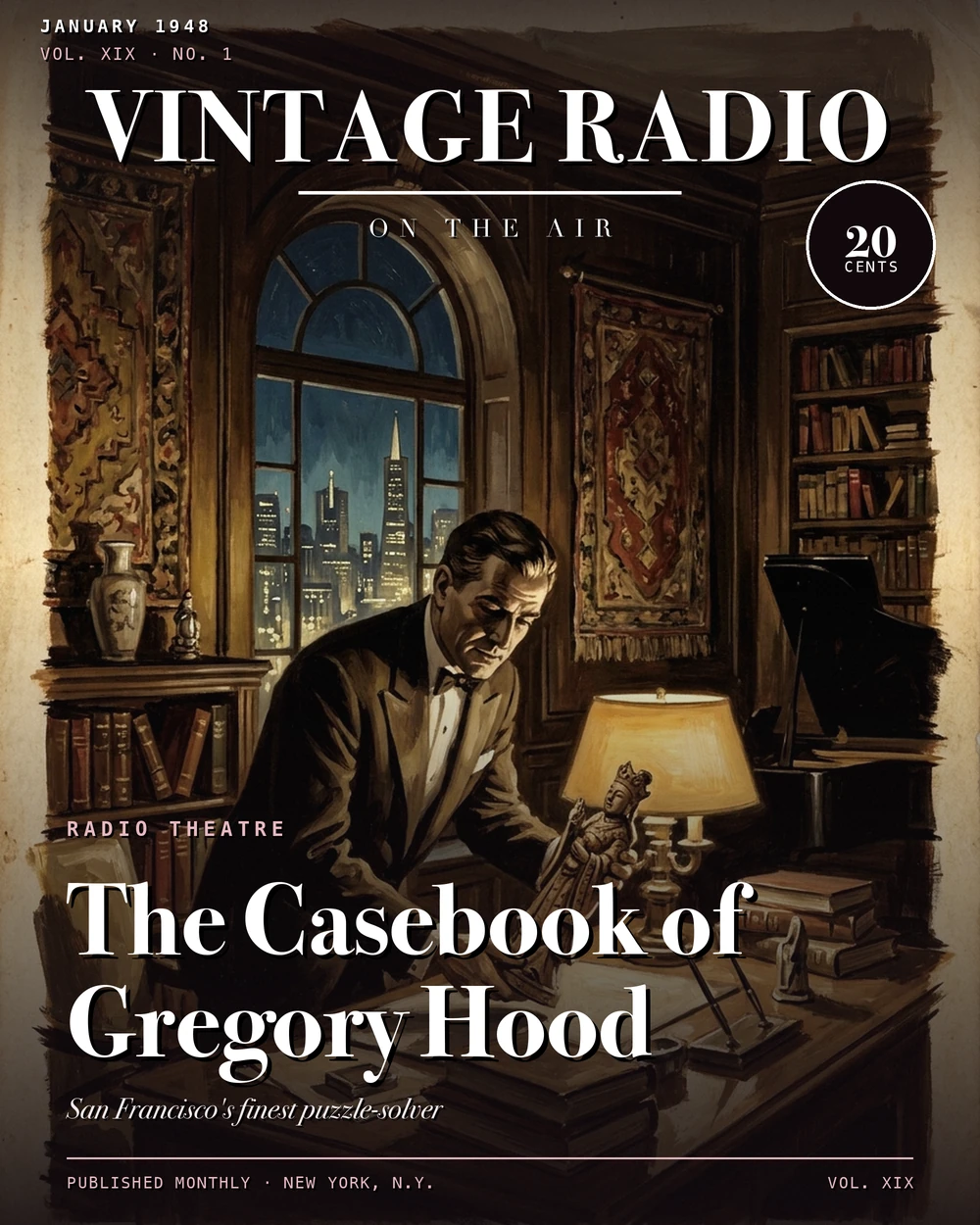
The Casebook of Gregory Hood
How It Got on the Air
The Casebook of Gregory Hood owes its existence to a contract dispute. In the spring of 1946, Basil Rathbone decided to walk away from his radio role as Sherlock Holmes, leaving Mutual without a prestige mystery drama and the Petri Wine sponsor without a timeslot to fill. The writers who had been plotting those Holmes scripts — Anthony Boucher and Denis Green — proposed a replacement: Gregory Hood, a San Francisco importer with a talent for solving crimes. The show premiered on June 3, 1946, in the Monday-at-8:30 slot Holmes had vacated.
What kept it running past that first summer was, again, a contract. Mutual failed to reach an agreement with the Conan Doyle estate to bring Holmes back to the network. When the Holmes series did return to radio in the fall of 1946, it moved to ABC with Tom Conway replacing Rathbone, leaving Mutual holding Gregory Hood instead. Petri Wine stayed on as sponsor for a full season before the program shifted to a sustained, unsponsored run. Hood moved to ABC in January 1950, airing Wednesdays at 8:30 and later Tuesdays at 8, until August 1950. Two final episodes aired on ABC in October 1951.
The show's structural debt to Holmes was not disguised. It used the same Petri Wine sponsor (initially), the same announcer introduction, the same narrator frame, and the same theme music as The New Adventures of Sherlock Holmes. Stories were told in flashback — a narrator would stop by Hood's home or office to hear him recount a case — a format Boucher himself linked to traditions going back to The Arabian Nights and the Sanskrit Panchatantra. Book reviewer Bertil Falk described it as "a frame story where Gregory Hood and his friend tell Harry Bartell a story from the casebook of Gregory Hood."
The Character and the City
Gregory Hood lived in a penthouse on San Francisco's Nob Hill, employed a Chinese valet named Fong, and worked as an importer by trade. His prototype was a real person: Richard Gump, a San Francisco importer who also served as a consultant on the show whenever the scripts needed accurate detail about the importing business. Gump appeared fictionally in at least one episode, "South of the Border," played by Bill Johnstone.
The character was built as a multidimensional figure — an accomplished pianist and composer, a self-taught forensics expert, fluent in several languages, an expert in ancient and modern armament, a wine connoisseur with an extensive rare cellar, and an acknowledged authority on oriental tapestry. He also had a military intelligence background, which gave his amateur detective work a professional underpinning. His companion, Sanderson "Sandy" Taylor, was not a conventional sidekick: Sandy served as Hood's corporate attorney and close friend, a more legally defined version of the Watson role.
The mysteries themselves were built around artifacts — objects discovered by Hood and Sandy that carried intriguing histories and turned out to be linked to some present-day crime. Surviving episode titles give a sense of the range: "The Adventure of the Beeswax Candle," "The Sad Clown," "The Eloquent Corpse," "The Double Diamond," "The Derringer Society," "The Forgetful Murderer." The scripts were designed as fair-play mysteries — in the words of the Crippen & Landru publisher's description, each case was "meticulously plotted so that the listener can, if he or she is clever enough, deduce the solution." San Francisco itself was woven into the scripts, with real locations, restaurants, and landmarks appearing regularly. According to release notes accompanying the series, cities reportedly flew the writers in to persuade them to set episodes in their locations.
The Writers Behind It
Anthony Boucher and Denis Green brought the show its strongest material, and understanding what each contributed helps explain its particular character. Boucher — full name William Anthony Parker White, born in Oakland in 1911 — was a devoted Arthur Conan Doyle scholar who worked out the plots. Green, born in London in 1905, was less enamored of "the master" and dialogued Boucher's plots from a more detached perspective. The partnership was conducted at a distance: Boucher lived in San Francisco, Green in Los Angeles.
Both men had done this before. They had written the bulk of the Sherlock Holmes radio dramas before Gregory Hood, and Boucher had also plotted more than 100 episodes for The Adventures of Ellery Queen beginning in 1945. Boucher went on to cofound The Magazine of Fantasy & Science Fiction in 1949 with J. Francis McComas, editing it until 1958 — the magazine that published Walter M. Miller's A Canticle for Leibowitz and nurtured Philip K. Dick. He won three Edgar Awards from the Mystery Writers of America for critical work (1946, 1950, and 1953), served as MWA president in 1951, and wrote 852 mystery criticism columns for the New York Times Book Review from 1951 until his death in 1968. The annual mystery convention Bouchercon, first held in 1970, and the Anthony Award, first given in 1986, both carry his name. He also wrote under the pseudonym "H. H. Holmes" — borrowing the alias of a 19th-century American serial killer — and signed light verse as "Herman W. Mudgett," the killer's real name.
Denis Green's background was unusual for a radio writer. He had served as a Flying Officer with the Royal Air Force until 1924, managed a tea estate in India from 1924 to 1928, and made his stage debut in Hamlet in 1928. His Hollywood credits ran from The Hound of the Baskervilles in 1939 to Mighty Joe Young in 1949. Beyond Gregory Hood and Holmes, he wrote for The Adventures of the Thin Man across all four major networks from 1941 to 1950. He died of heart failure in New York City in November 1954.
Ray Buffum also contributed scripts. Directors across the run included Ned Tollinger, Frank Cooper, and Lee Bolen, with sound effects handled by Art Sorrance.
A Revolving Cast
If the writing gave the show its backbone, the casting history gave it instability. The role of Gregory Hood changed hands at least five times across the run, and the role of Sandy Taylor was played by at least five different actors as well.
Gale Gordon created the role and played Hood for at least the first ten episodes. Gordon, born Charles Thomas Aldrich Jr. in New York City in 1906, was born with a cleft palate; his theatrical parents — vaudevillian Charles Thomas Aldrich and English actress Bertha Wilson (known as Gloria Gordon) — encouraged him into show business partly to help him overcome it, and his distinctive vocal delivery was originally developed through speech therapy. He made his first radio appearance in 1926 at KFWB in Los Angeles, singing and playing the ukulele, and by 1933 he was the highest-paid radio actor in Hollywood. He had appeared in the final episode of The New Adventures of Sherlock Holmes on May 27, 1946 — promoting the new Gregory Hood series — and launched Hood the following week. After completing his initial episodes, Gordon was unwilling to commit to further appearances. When Elliott Lewis arrived to take over, Gordon had not been informed of the change; according to accounts of the transition, Lewis was the one who told him. Gordon was inducted into the Radio Hall of Fame in 1999.
Elliott Lewis took over the Hood role on March 1, 1948. CBS Radio Publicity called Lewis "Mr. Radio" for his combined contributions as writer, producer, director, and actor across more than 900 network radio programs. He had made his radio debut in 1936 after being spotted in a college play at Los Angeles City College, and during the war he served as a master sergeant, producing roughly 120 shows for the Armed Forces Radio Service. After his stint as Hood, Lewis went on to produce and direct CBS Radio's Suspense from 1950 to 1956 and Crime Classics in 1953–54, and later produced The Lucy Show on CBS television in 1962.
Jackson Beck played Hood around 1949. Beck (1912–2004) had a broad radio career that included delivering the iconic opening of The Adventures of Superman and playing Beany Martin the copyboy as the Jimmy Olsen character evolved. He was also the first actor to portray Batman's butler Alfred Pennyworth on radio. Paul McGrath and Martin Gabel held the Hood role at various points, and George Petrie may have taken over at the start of the ABC run.
Howard McNear took over as Sandy Taylor on March 1, 1948 — the same date Lewis assumed the Hood role. McNear is best known to television audiences as Floyd the barber on The Andy Griffith Show. Before McNear, Sandy had been played by Bill Johnstone and then by Art Gilmore, who typically worked as an announcer on programs including Amos & Andy and Dr. Christian. Carl Harbord and William Bakewell also took the part at different points.
Boucher grew increasingly frustrated with the situation. In personal correspondence, he wrote: "My relations with the agency controlling the Hood program have become so unsatisfactory that I have no desire to build up their property for them, nor to associate myself too closely with it." According to Jeffrey Marks's biography of Boucher, the rotating cast was central to his dissatisfaction.
What Survived
More than 150 episodes of The Casebook of Gregory Hood were produced across its run. As of a maintained set released in April 2022, fewer than 20 complete episodes were known to exist. The last circulating survivor dates to October 15, 1949 — "The Carnival of Death," starring Jackson Beck — which means the entire ABC run of 1950 and the 1951 finale episodes have left no known audio record.
The scripts fared somewhat better. In 2009, Crippen & Landru Publishers of Norfolk, Virginia, published a collection of 14 previously unpublished Gregory Hood radio scripts, edited by Joe R. Christopher, as the 28th volume in their "Lost Classics" series devoted to uncollected works by classic mystery writers. Additional scripts remain among the Boucher papers held at the Lilly Library at Indiana University. The published collection drew attention to the San Francisco geography woven through the stories and to the show's standing as a carefully constructed fair-play mystery series — one that has been compared by OTR researchers to Pat Novak for Hire and Boston Blackie in its atmospheric approach to the city, though Hood occupied a considerably more refined social world than either of those protagonists.